

When Roberta Wilson stepped away from her career at MTV Networks after more than two decades, she wasn’t thinking about cannabis or starting another business. She was simply worn out. Years of constant travel and high-stakes deadlines had taken their toll, and she wanted a pause.
Life, however, had other plans. Not long after her departure, Wilson’s mother, Audrey, passed away suddenly at the age of 72. Audrey was a pharmacist by profession, but outside the pharmacy, she was known best for her baking. Her chocolate chip cookies weren’t just snacks—they were a ritual, a point of connection, and, in her own way, a kind of medicine.
“She believed in her heart that they were better at curing life’s ails than anything she dispensed in the pharmacy,” Wilson shared with The Emerald.
In grief, Wilson decided to keep that tradition alive. She launched Audrey’s Cookies, selling her mother’s recipes at local farmers’ markets. The venture quickly grew, landing products on the shelves of major retailers. While the company eventually closed, it taught Wilson lessons about scaling a food brand, navigating supply chains, and managing the unpredictable realities of the gourmet food business. Those lessons would resurface later, when a different opportunity came knocking.
From Family Traditions to Edibles
By 2017, California was on the cusp of legalizing recreational cannabis. The shift sparked countless new ideas across the state, and for Wilson, one of them came in an almost offhand way. She joked to her brother Jeff, “We should do weed cookies.” Instead of brushing it off, he leaned in. Together, they began exploring what it would look like to enter the edible space.
The siblings eventually co-founded Dr. Norm’s, a company named after their father, Norman, a Los Angeles physician remembered for his warmth and devotion to patients. While the name was new, the values behind it were familiar. Their parents had modeled both care and creativity: Audrey in the kitchen, Norman in the exam room. The challenge was figuring out how to translate those lessons into a cannabis landscape that was often confusing, inconsistent, and still stigmatized.
“When we first started, everything we tried tasted like you were biting into a joint,” Wilson explained. “It was clear that people deserved better.”
Their aim became twofold: create edibles that people genuinely wanted to eat and ensure that each dose delivered a predictable experience.
Building Trust Through Flavor and Consistency
Dr. Norm’s launched with cookies inspired by Audrey’s recipes. From the beginning, Wilson and her brother focused on portion control and dosing transparency. At the time, cannabis edibles often came in oversized brownies or candy bars, leaving consumers to guess how much THC they were actually consuming. The siblings worked to offer smaller, individually dosed items.
“One side of a cookie would get you high, and the other side did nothing,” says Wilson. “There was zero accuracy in dosing. Everyone had a horrible story about getting over-medicated.”
Over time, the product line grew to include brownies, crispy rice bars, chocolates, and gummies. Beyond just adding variety, the expansion reflected their effort to make cannabis accessible in different forms while holding onto two priorities: taste and reliability.
The company also began experimenting with technology. One innovation was nano-emulsification, a process that shrinks THC into tiny, water-compatible particles the body can take in more efficiently. Instead of the traditional 45 to 90 minutes that edibles often take to kick in, Dr. Norm’s aimed for closer to 15 minutes. The goal wasn’t just speed, but predictability—helping consumers feel more in control of their experience.

Expanding Into Wellness
As the cannabis industry matured, Wilson and her brother saw that many consumers were interested not only in recreational use but also in targeted wellness products. Dr. Norm’s introduced a line that included gummies, tablets, and vapes designed for specific needs like sleep support, pain relief, or higher-dose use for experienced consumers.
Each product was formulated with a mix of cannabinoids—THC, CBD, CBN, and CBG—reflecting a growing understanding that these compounds can work together in distinct ways. For instance, the company’s sleep gummies pair nano-emulsified, fast-acting THC with longer-lasting distillate, a purified oil that extends the effects. The idea is to help people fall asleep quickly and stay asleep through the night. Their pain tablets take a different approach, combining low doses of THC with a higher concentration of CBD and other cannabinoids, designed to ease discomfort without overwhelming psychoactive effects.
Rather than presenting cannabis as a cure-all, Wilson frames these products as tools, part of a broader conversation about how people manage their health and well-being.
Following Trends Without Losing the Core
Some of Dr. Norm’s creations are less about targeted effects and more about food culture, reflecting broader culinary trends. Their Fruity Crispy Rice Bars echoed the nostalgia of childhood snacks, while Fiery Hot Crunch Bars tapped into the popularity of spicy treats.
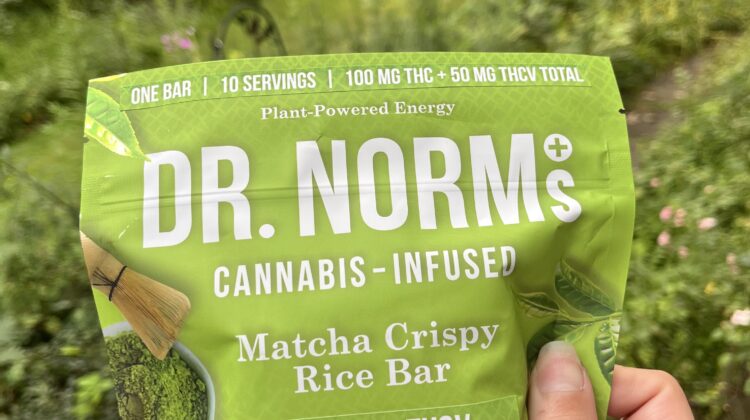
One of Dr. Norm’s more niche releases is the Matcha Crispy Rice Bar, which blends cannabis with powdered green tea. Each bar is scored into 10 servings, with 10mg THC and 5mg THCV per piece (100mg THC and 50mg THCV in total) plus the natural caffeine that matcha is known for. The result is a rare edible that can sharpen focus and provide a gentle lift in energy.
“People have become extremely passionate about matcha,” Wilson explained, adding that the company tries to respond to shifts in taste and culture without losing sight of their focus on flavor and consistency.
Carrying Legacy Forward
At its heart, Dr. Norm’s remains a family story. Audrey’s love of baking and Norman’s dedication to medicine continue to shape how the company operates. For Wilson, this legacy is less about nostalgia and more about values: care, trust, and the belief that food can provide solace. By extension, cannabis can bring comfort too.
Those principles remain steady even as the company introduces new formats, flavors, and wellness products. Wilson often describes the brand’s role as providing something people can rely on in an industry that has not always earned that trust.
The journey that began with one mother’s cookie recipe has evolved into a broader exploration of what cannabis edibles can be: approachable, thoughtful, and grounded in family tradition. For Wilson, it is also a way of keeping her parents’ spirit alive—honoring both the baker who brought joy to her community and the doctor who cared deeply for his patients.
“My parents would have bought into hook, line, and sinker to cannabis as a wellness option,” says Wilson. “I wish they were here to see it, but every day I feel like we’re carrying them forward.”
Leave a Reply